
 In the latter half of the 19th century, western Sedgwick County was mostly vast prairie. But as civilization moved ever westward, more and more people began to settle on the fertile prairies, converting them from a sea of grass to profitable family farms.
At this time, there was a great influx of German immigrants coming to America to escape religious persecution and being forced into feudal wars in Germany. Many of these immigrants were attracted to the west Sedgwick County area, where the fertile farm ground promised good crops. Newspapers and magazines across the country advertised for Catholic families to settle in this area. Already, there were German Catholic settlers in St. Mark and St. Joe, Ost, and as land was homestead in those areas, they began to spread out and form new communities.
In 1885, the railroad came through the area and two settlers, George Anderson and J. Will Dale, chartered a new town next to the railroad. They named the town Andale, a compound of their last names.
The first German settlers in Andale had to attend Mass in St. Mark because there were not enough Catholics in Andale to warrant a parish. By 1890, however, the Catholic population had grown, and with the encouragement of the founders, George Anderson and Will Dale (both non-Catholics), the community began discussing the need for their own church. Anderson and Dale agreed to donate land on Main Street and in April, 1890, they called upon LC Fouquet and John Gorges to make a trip to Wichita to visit Bishop John J. Hennessey to ask that they be allowed to build a Catholic Church in Andale. The Bishop agreed to visit Andale, and did so on April 28, 1890. Bishop Hennessey, along with Monsignor Schmiehausen of St. Mark, and Father Loevenich of St. Joe, Ost, were guided by Fouquet and Anderson to various suggested sites along Main Street. The Bishop decided that the cornfield at the north end Main Street would be a fitting site for the new church, making it a prominent feature in the town's landscape. The land was promptly donated by Anderson and plans were started for the long-awaited church.
Monsignor Schmiehausen was in charge of Andale as a mission and he saw to it that collections for the new church began almost at once. Not only was money collected from the Catholics of the Andale area, but also from most non-Catholics, who were as eager to see the church built and the community grow as the future parishioners were.
Soon, the little country church was being erected. It was small, only 26' by 45', but as there were only a small number of families, it was adequate. The foundation was laid at a cost of $49.30 and before they knew it, the walls were up and the only thing left was the roof. Then disaster struck! A small cyclone ruined the unfinished structure and everyone felt it might be the end of the little parish since money was so scarce. Fortunately, Bishop Hennessey had the good foresight to insure the building at a cost of $15.30. Repairs were quickly made and soon the finishing touches were put on the rebuilt church.
Although it was a simple wooden building, the finished church looked beautiful to all who worked hard to get it. The final cost of the new church was $1,474, and because of the generous donations by local businesses and residents, the debt after construction was only $132.
On December 21, 1890, St Joseph parish dedicated their new church. It was a beautiful day; clear, sunny, and cold! The people felt they had truly been blessed in coming to the New World and to Andale.
High Mass was said by Bishop Hennessey. The church was filled with people standing everywhere. Many of the people who attended were non-Catholics, and there was a wonderful spirit of friendship among the different denominations comprising the community at that time. After the dedication, the ladies of the parish served a delicious meal for the visiting dignitaries and the local people.
Because Andale was a mission of St. Mark, they had services only on the 2nd Sunday of each month. Monsignor Schmiehausen also had to travel to Halstead and Afton, now called St. John's in Clonmel. It is also interesting to note that while the Mass was said in Latin, the sermons and confessions were said in German. At the time, and for several decades to follow, there was only one English speaking family in the parish.
The first permanent pastor of St. Joseph's was Father George Engelbert Meyer, who was appointed pastor on February 14, 1891. He also had Halstead and Afton as missions. Father Meyer was born in Cloppenburg, Germany.
Father's first order of business was to build a rectory and establish a cemetery. A two-story frame rectory was built just east of the church. It was complete in 1891. For the cemetery, he bought 4 acres of farm ground from Mr. Korte for $252. Although Father and the parents of the parish would have liked to start a parochial school, there were not enough funds to support one. Father did the next best thing; he formed a summer school for the purpose of teaching religion and German.
The parish was greatly saddened when Father Meyer died of consumption (tuberculosis) on February 3, 1898. He was only 35 and became the first priest buried in the cemetery he helped establish.
The 2nd pastor to St. Joseph's was Father Leonard Epp, appointed in June, 1898. He was born in Balzfeld-Brade, Germany. Father Epp found in Andale a congregation of German immigrants, who like himself, were constantly striving to grow and improve their parish. To that end, Father Epp saw the need to expand the little church and added two wings at a cost of $1651. Father Epp also oversaw the building of a frame schoolhouse for a parochial school. It was built in 1901 to house four classrooms, with the living quarters for the two nuns who taught on the 2nd floor.
Because of failing health, Father Epp had to resign in 1904. Although he returned to Germany, he remained close to his parish in Andale. He sent two large donations for the second church and corresponded with members of the parish until his death in 1925. He was buried in Heidelberg, Germany.
Bishop Hennessey appointed Father John Loevenich as the third past of St. Joseph's, and like his predecessors, he was born in Germany. Father Loevenich had an excellent reputation as a priest and was known to be an outstanding organizer, a trait that was much needed as St. Joseph's decided to build a new church. With Catholics moving to the area at a rapid rate, the small frame church was to small. Father envisioned a grand church that he planned to be the most impressive in Kansas.
On November 11, 1911, construction began on the new church. The first order of business was to move the old church. I was pulled west and then back north, behind the school. Services went on in the first church as the second one was being built. The last service was held on Ascension Day, May 1, 1913. It was then used as a dining and meeting hall.
The cornerstone to the new church was laid on May 16, 1912. Shortly after that, Father Loevenich's health began to fail and he was forced to resign on October of 1912. He remained in Andale until his death. He died here on April 3, 1914, and his funeral was on April 6, in the church he had planned. He was buried in the cemetery beside Father Meyer.
Monsignor Bernard Schmiehausen, born at Frechenhorst, Germany, was assigned as the next pastor. The Andale community knew him well, from the time when Andale was still a mission of St. Mark's, where Monsignor was pastor. So, not only was Monsignor Schmiehausen in charge of seeing the first church built, now he would be in charge of finishing the second church.
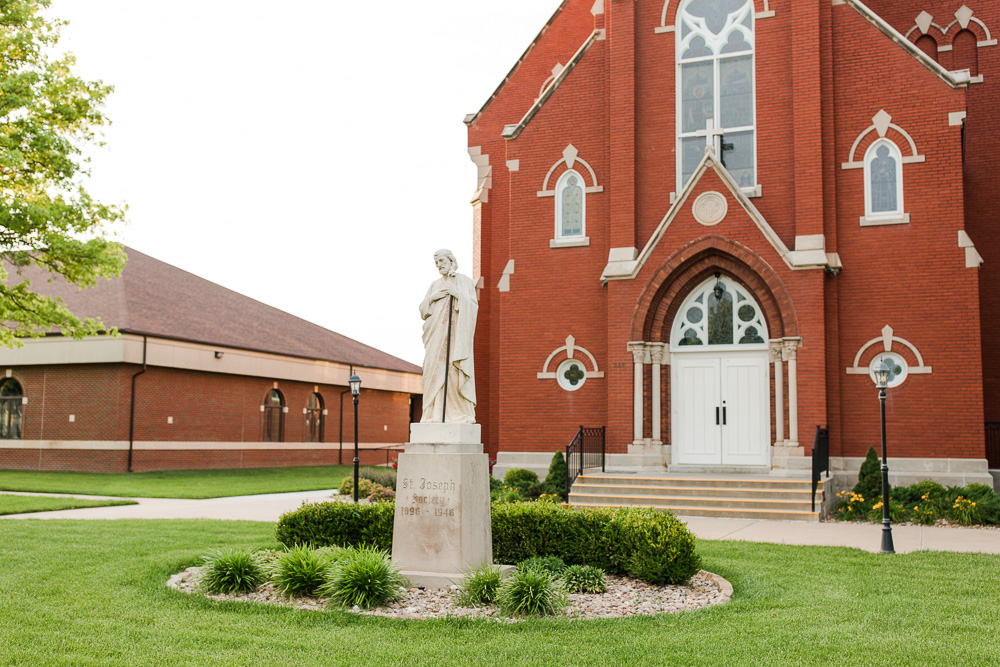
The new church was erected up to the roof when Father Loevenich was forced to resign. As the outside of the church was nearing completion, the spire was placed on November 24, 1912. At the time it stood 165 ft. above the ground, making it the highest structure in the country outside of Wichita. The final cost of the new church was a little over $50,000.
 Finally, the church was finished and the parish prepared for the dedication on Sunday, May 20, 1913. Although the day was overcast and rainy, it did not dampen the enthusiasm of all of Andale that day. The church, as well as the whole town was splendidly decorated with streamers, flags, and buntings. A special train brought the Bishop, clergy and Wichita people; with another special train coming from the west with people from the western parishes.
The AHS Band was at the depot to greet the trains and a procession of clergy, dignitaries, parishioners, and townspeople made its way north on Main Street to the new church as the bells pealed forth and the band played. Once there, the church was blessed and the Solemn High Mass was said. Afterwards, dinner was served in the school and former church.
Another accomplishment of Monsignor's was the construction of the new rectory, costing nearly $18,000 and completed in 1917. The two-story building was a fitting match to the architectural design of the church next door.
On May 25, 1917, Monsignor Schmiehausen was called upon to minister to his parish in a very tragic situation. At around 2:00 p.m. that afternoon, the skies darkened and a tremendous tornado struck the southeast part of the town. While the church, school, and rectory were spared of significant damage, many others in Andale did not fare so well. The death toll in Andale that day was 13 and the weather bureau called it the worst storm in Kansas up to that time. The public school was completely destroyed, as well as many homes and businesses.
Monsignor Schmiehausen passed away suddenly and unexpectedly on October 29, 1923. The death of the beloved pastor and able leader at the age of 67 was a shock to the parish. His funeral was on November 3, 1923 in St. Joseph church, the church he helped to complete. He is buried in the priest's lot in the cemetery.
Father John Grueter became the next pastor of St. Joseph's on December 5, 1923. He was born in Cologne, Germany. Father remained at Andale for 16 years. While pastor, he started a high school on the 2nd floor of the new parish school. Probably the most notable project was the purchase of the stained glass windows, the beautiful windows that now grace our church. Father Grueter died in 1940 of heart trouble in the rectory. He too, is buried in Andale's cemetery.
After the death of Father Grueter, Monsignor Klug was appointed his successor on June 30, 1940. He remained at St. Joseph's for 21 years. He was born in Odin, Kansas, the first priest at Andale not born in Germany.
During Monsignor Klug's tenure as pastor, he was able to get the stained glass window project completed, and even helped design the window over the main entrance to the church. He also renovated the rectory, adding the east addition as well as removing the 2nd story. The church was also redecorated and updated during his time. Monsignor left Andale on July 7, 1961, to become the chaplain for St. Luke's Hospital in Marion, Kansas. He retired in 1966 and passed away on October 8, 1981. He is buried in Odin, Kansas.
Following the resignation of Monsignor Klug, Monsignor Edward Albers became the pastor on July 21, 1961. Although he was at Andale only 4 years, he remained dear to the hearts of the congregation until his death in 1965. On October 19, 1965 Monsignor Albers suffered a heart attack at the Cheney Bowling Lanes. Although an attempt was made to revive him, he passed away at the bowling alley. He was buried in St. Leo, Kansas, his hometown.
The next pastor to serve St. Joseph's was Father Robert Pepe. Born in Buffalo, NY, Father Pepe was appointed to Andale on February 12, 1966. During his tenure, a new altar was installed that faced the congregation. He also installed a new boiler system, air conditioning, and the automatic door locks. Father Pepe left Andale on June 30, 1976 when he was transferred to St. Rose, Columbus. He retired in 1996 and died on August 27, 2012. He is buried in Ascension Cemetery in Wichita.
Replacing Father Pepe was Father Reinhard C. Eck, who became pastor on July 5, 1976. Father Eck was quite at home at Andale, since his home parish was St. Joseph, Ost, just a few miles away. He was one of three priests to come from his family of 11 siblings. Father Vincent, was the oldest, Father Reinhard was the middle and Father Ivan was the youngest.
Father Eck was known for his traditional outlook and deep reverence for the historical tenets of the Catholic Faith. He was also known to be a great counselor and listener. Many people came to him for help and advice, not only his parishioners, but people from all around the area. If you were sick or in trouble of any kind, you could always be assured that Father Eck would lend a willing ear and a sympathetic heart.
Many changes and improvements were made to St. Joseph's while Father Eck was pastor. The church was redecorated, repainted, carpeted, and re-carpeted, during his time. The wheelchair ramp was added and the organ was renovated and new pipes were added. Major changes to the physical layout of the parish were made when the parish school, which was being used by Renwick school district, was demolished, as well as the convent. This made room for a new, modern parish hall and a paved parking lot. The buildings were torn down in 1993 and the hall built in 1994. In addition to facilities for large and small gatherings, there are classrooms for religious instruction for K-12 students.
Father had to oversee repairs from two major storms during his time. The first, in 1981 damaged the steeple, with repairs costing $110,951.01, which was about double what the church had cost to build! The second storm was in 1990 on June 19. The violent storm blew out 3 of the stained glass windows on the west side, including the large window depicting the Coronation of Mary above the west confessional. The steeple also sustained damage a well as there being extensive water damage throughout the church. Luckily there were pictures of the windows and by using those and pieces of the original glass; the windows were restored to their original glory.
It was also during Father's Eck's time that the parish celebrated its Centennial. On May 27, 1990, A grand celebration, months in the planning, got underway. The day began with a noon mass celebrated by Bishop Eugene Gerber. Following Mass was a parade, which sported almost eighty entries and was nearly an hour long. The day was filled with home-made food, antique and religious items on display, children's games, a Maypole Dance, and ending with a town dance under a tent on the parish grounds. It was indeed a memorable day.
Father Eck Came to Andale in 1976, and it seemed as if he would always be with us. Of course, this could not be, and on June 30, 2012, Father took a medical leave of absence. He was 88 years old and had ably served St. Joseph's parish for 36 years, the longest of any pastor at Andale. It was with very heavy hearts that the parishioners came to grips with the loss of their beloved pastor, and unfortunately, many were able to visit Father at the Catholic Care Center, where he spent his last days. On August 12, 2012 the news began to spread- Father Eck had passed away, surrounded by his family. His funeral was August 16, 2012, at St. Joseph's in Andale, and was attended by over 600 people. After a lunch served by the Altar Society, Father Eck was laid to rest at his beloved St. Joseph, Ost.
On July 1, 2012, St. Joseph's was once again blessed with a new priest, Father Joseph Gile. Born in Wichita, Kansas, his home parish was Blessed Sacrament. He ha the daunting task of following the 36-year pastorate of Fr. Reinhard Eck. During his time a new rectory was built with funds donated by The Raymond J Clasen Estate along with the donations and labor of many people of the parish.
Father Ben Nguyen (July 2014 to June 2015) During his time the parish developed the Parish Council and the Stewardship Committee. These groups help people of the parish to discover their talents and to serve the life of the church and the community.
Father Daryl Befort (July 2015 to June 2024) Fr. Befort was a carpenter. During his time, he oversaw the finishing of classrooms in the basement of the parish hall. He brought together a committee to plan the renovation of the church.
Early Sunday morning at 4:04 a.m., June 24, 2018 a thunderous and extraordinarily powerful storm jolted the heart and soul of Saint Joseph Andale parish. A lightning bolt of epic proportion had struck the church steeple that lasted four seconds. The lightning had overwhelmed the lightning rod and the ground cables. One cable, attached to the lightning rod mounted on the cross at the top of the steeple was blown apart from the energy of the strike. Video then showed a huge fireball coming from the steeple and landing on the east side of the roof near the steeple. That is where the fire started.
Firemen emptied our 150,000-gallon city water tower in effort to bring the fire under control. Father Before entered the Sacristy and rescued the Blessed Sacrament. Firefighters from Andale, Sedgwick County and Wichita battled the fire for hours.
Immediately there was a plan. Father Befort alerted everyone that Sunday Mass would be said in the Andale High School Auditorium at 10 o'clock. Just as St. Joseph comforted the Holy Family, so did Father Befort comfort his parish family. His homily offered the ray of hope and consolation that everyone needed to begin healing. He announced "We'll rebuild as the church is insured for full replacement value. The church is structurally sound. It was built on 18-inch-thick brick walls." That same evening the parish family gathered to say a Rosary. Hotdogs were served. Bishop Carl Kemme offered prayers and encouragement to the many parishioners there.
Monday morning, June 25, 2018 men, women and children arrived at the church ready to help in anyway possible. Men willing to do the heavy lifting loaded pews and altars onto waiting trucks and trailers lining the streets. The "furniture," statues and stations of the cross removed and transported to a storage location where they could dry out, be salvaged and repaired at a later date. The original wood doors that once separated the church's nave an vestibule were saved and moved to safety. The goal of the day was to remove everything from the sacristies, nave, sanctuary and basement to places of safe keeping.
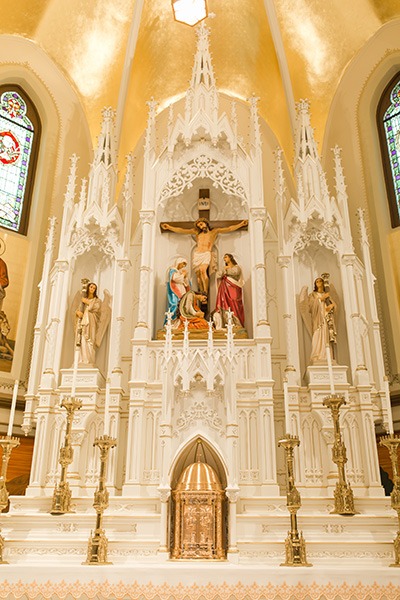
After the fire, the church's interior was a blank canvas. Father Befort formed a design team that would meet weekly or every two weeks for months. Churches need Re-Dedication when major renovations, as ours had, occur. Father Befort had scheduled Monday, March 18, 2019 as the day for the Re-Dedication of the church. That meant Bishop Kemme was coming along with many priests from all over the diocese.
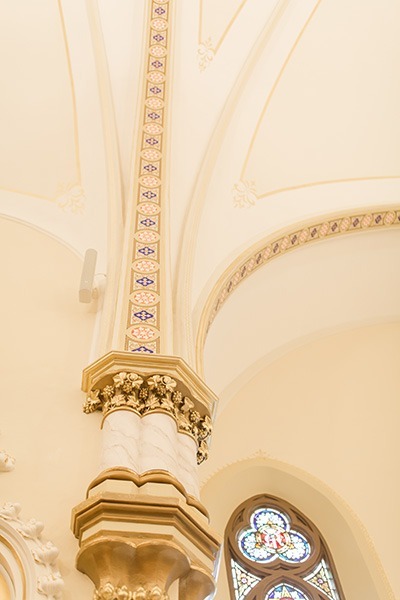
With careful planning and great dedication, the renovation of the church was completed by St. Joseph's Day 2019. Since that day we have enjoyed the beauty of the Church. This sacred space allows us to elevate our minds to the glory of God. Visitors from all around the diocese and the nation come to our parish to see our beautiful church.
Fr. James Weldon (July 2024 to present) St. Joseph continues its long-standing custom of release time for religion during the school day. Each week students receive two hours of religious instruction. This custom is a great way to hand our Catholic Faith to our young people. We should never take it for granted, and it will require vigilance to maintain this cooperation with the public school system. Darlene Matzek completed 50 years of teaching religion. Mary Jo Hieger has been the Director of Religious Instruction for 34 years. We are very grateful to them and to all our teachers for their dedication to our young people.